Sunday, November 17, 2013

9. AND NOW FOR SOMETHING COMPLETELY DIFFERENT!!!

SATURDAY NOVEMBER 16, 2013

If you read our blog from our first trip to Japan in February, you will remember our friends Shinsuke and Maho.

Today they are going to take us Hakone.
The view from our Bethel room window tells us that this is the perfect day to go to Hakone. Fujiama is clearly visible and there is not a cloud in the sky.
Dashboard cam...
 
When we arrived in Japan 6 weeks ago, the mountain was black but now...

The autumn weather has arrived and we are off to visit the Sekirakuen Garden.

Japanese Maple trees known as Momiji (reddened leaves).


The moss garden.


The pebble garden.


I absolutely fell in love with these cast iron pendant lanterns.
 
Shinsuke collecting leaves too.
 
Someone's granddad taking a photo... Actually, what we should have photographed was the hundreds and hundreds of Japanese people crowded into this piece of paradise each with a digital camera... Who could blame them.
Yet, we managed to photograph the garden to look as if we were here alone...


The perfect lunch to compliment a Japanese garden.
Notice the maple shaped carrot?
Now I know what your thinking, we titled this blog, AND NOW FOR SOMETHING COMPLETELY DIFFERENT, but so far, we have not done anything radically different... Well...
Today we went to our first onsen, or traditional Japanese hot spring. Can you see the nervous look on our faces?
According to Wikipedia, An onsen (温泉?) is a term for hot springs in the Japanese language, though the term is often used to describe the bathing facilities and inns around the hot springs. As a volcanically active country, Japan has thousands of onsen scattered along its length and breadth. Onsen were traditionally used as public bathing places.
To help us to prepare our friends sent us following web address;

http://www.japan-guide.com/e/e2292_how.html

The sign says mens onsen.
This photo is taken from the Gotemba Onsen website.
http://www.otainai-onsen.gr.jp/Onsen.htm
Obviously, no photos can be taken inside the onsen... So here is one that I have borrowed from Wikipedia to give you the general idea...
As they say, "when in Japan, do as the Japanese do"... Thank you to our dear friends Shinsuke and Maho for a wonderful day. This truly was an experience to remember.
Lloydnalex


Saturday, November 09, 2013

8. YOKOHAMA HARMONY - THE SANKEI-EN GARDEN

Sunday November 3, 2013 continued

Our favourite thing to do in Japan is ... visit japanese gardens.

This is the Sankei-en garden. A traditional Japanese-style garden which opened in 1906. Designed and built by Local silk trader who it seems did rather well for himself.
The layout.
The Gomon gate (1708) originally from Kyoto.

Decoratey carved cedar base on granite pedestal but that is not the best bit...

My favorite is this is beautiful example of a Japanese interlocking timber post joint. No decoration is needed when the material, form and function are so perfectly in harmony. Something as ingenious as this simply must have a name but I have been unable to find it. If you know what it is called, please tell me.
The base segment has evidently been replaced but will eventually develop a darker weathered appearance.

2013-11-23 UPDATE.

Thank you my mate Shinsuke for tracking down some details and information about the Japanese carpenters joint. It is called Kanawatsugi, or for a less romantic English language name; the "oblique, housed (dadoed), rabbeted, T-shaped, half-blind, tenoned scarf joint". Anyway, the following is borrowed from the web site; http://www.aisf.or.jp/~jaanus/deta/k/kanawatsugi.htm

An oblique, housed (dadoed), rabbeted, T-shaped, half-blind, tenoned scarf joint. Because both the tenon and mortise are blind, the joint cannot be slipped together from the side, as in an oblique, housed, rabbeted, scarf joint *okkake daisentsugi 追掛大栓継. The oblique surface on the mortised half of the indented part is decreased by the depth of the rabbet. Therefore, the end with the inverted T-tenon on the corresponding piece must be inserted in a lengthwise direction. Then a joining draw pin komisen 込栓 (see *sen 栓) is driven through the opening provided in the center to lock the joints. Sometimes two keys *shachi 車知 are used in place of a draw pin to strengthen the joint. This joint is commonly used in foundation footings *dodai 土台, wall plates *daiwa 台輪, the beam used for the bottom tracks for sliding doors or window *shikigeta 敷桁, and in eave purlins *dashigeta 出桁. The improvement in carpenter's tools in the Edo period made it possible to fashion complex joints such as this.
I'll be looking for more of these in the future...


This traditional house called Hakuuntei was built in 1920 by the silk trader as a little retreat for him and his wife.

Looks like somthing out of a paradise illustration to us.
Always time for another tea lesson.
The matcha whisk, or chasen...
Handcrafted from one piece of bamboo, a thing of beauty.
No, no, no!!! Not that way, this way!!!
It's Matcha time. Powdered green tea with a traditional sweet served on a cedar plate.
Another obi.
Enormous chrysanthemums, about the size of a cabbage...
And then, there are the bonsai chrysanthemum. Who knew?
The 3 storey pagoda, built in 1456 and moved here in 1914.
The artist, the photographer and the pagoda.
The Yanohara family Edo Era family house.
New friends
The family room.

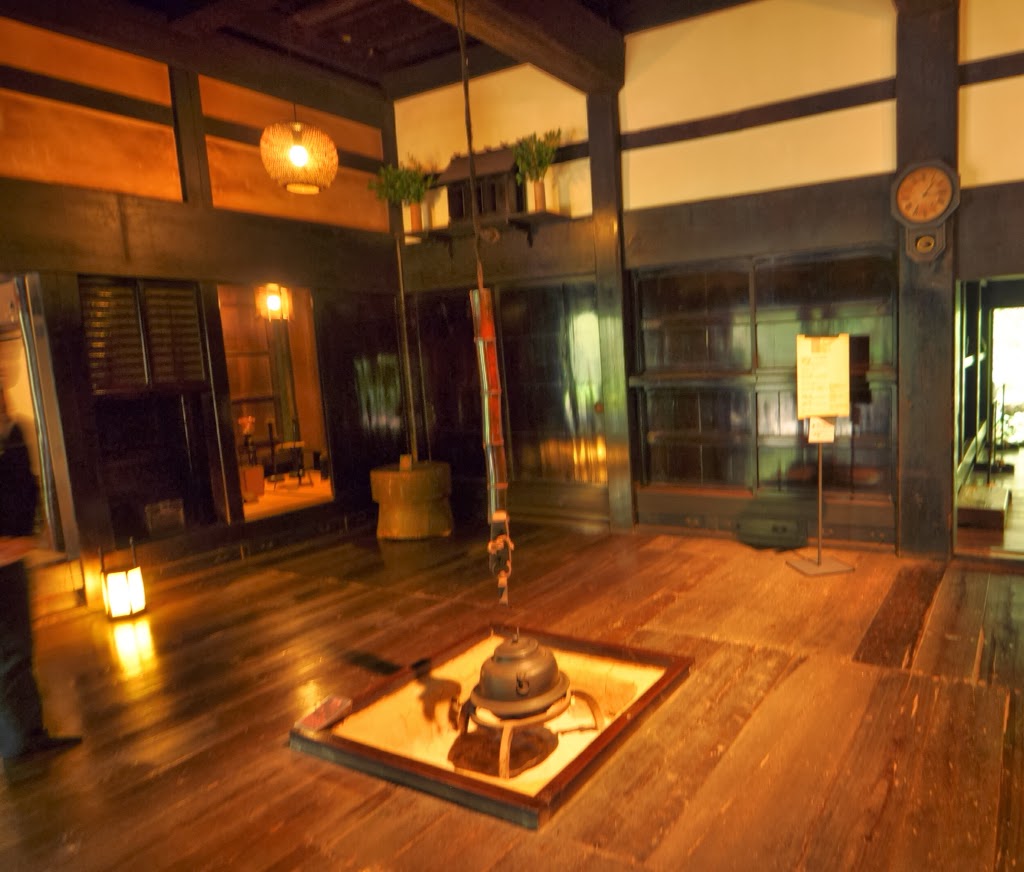
The kitchen.
A large tatami room reserved for visiting dignitaries. Wife and children were never allowed to enter...
Screen detail.


Kanshinbashi bridge.


A 1634 Buddhist Sanctum famous for providing refuge for women seeking release from marriage
Seiji and Kyoko enjoying the the refuge of marriage.
Thank you for a very memorable weekend.
Lloydnalex